
Grab a piece of paper right now, set a timer for 60 seconds, and write everything your brain is currently worrying about. Don't edit. Don't punctuate. Just dump it. When the timer stops, write one sentence: "Right now, at this moment, I am safe and I can handle one thing at a time." That's the whole routine. You can do it before you read another word.
That 60-second worry dump works because it moves anxiety from the loop inside your head onto a surface outside it. The research backs this up, and the rest of this guide gives you the techniques, prompts, and templates to build on that first minute.
Key Takeaways
Journaling reduces anxiety most reliably when you use a structured format, write toward insight rather than pure venting, and review entries weekly rather than obsessively.
| Point | Details |
|---|---|
| Start with 60 seconds | A one-minute worry dump plus one grounding sentence is a complete, effective first session. |
| Match format to anxiety type | Use expressive writing for diffuse worry, CBT thought records for specific thoughts, gratitude for negativity bias. |
| Language predicts outcomes | Entries using causal and insight words ("because," "I realize") produce better results than pure emotional venting. |
| Review weekly, not daily | A weekly scan of entries reveals trigger patterns; daily re-reading tends to feed rumination instead. |
| Life is a Game adds structure | The app's AI Therapist and habit tools complement journaling with guided CBT support and progress tracking. |
Table of Contents
- How does journaling for anxiety actually help?
- What does the science say about writing and anxiety?
- How to start a journaling habit that actually sticks
- Which journaling format fits your anxiety?
- Journal prompts for anxiety you can use right now
- Three templates you can copy and use today
- How to review your entries and spot anxiety patterns
- When journaling can make anxiety worse
- An honest note on what journaling can and can't do
- A structured complement to your journaling practice
- Further reading and primary sources
- Sources
How does journaling for anxiety actually help?
Anxiety thrives in the abstract. The moment you write a worry down, you force it to take a specific shape, and specific things are easier to deal with than formless dread. Several mechanisms explain why this works:
- Working-memory offload. Your brain has limited short-term capacity. Writing a worry down frees that space, the same way clearing RAM speeds up a slow computer. Research on expressive writing shows this effect is measurable at the neurological level.
- Attentional shift. The act of writing pulls you out of the anxiety loop and into a task. You become the observer of the worry, not the person trapped inside it.
- Cognitive reappraisal. Putting feelings into words activates the prefrontal cortex, the part of the brain responsible for rational evaluation. You start to see the thought as a thought, not a fact.
- Pattern recognition. Over time, entries reveal which triggers, times of day, or situations reliably spike your anxiety. That data is hard to collect any other way.
- Ritual and predictability. A consistent journaling habit creates a daily moment of controlled processing, which itself reduces baseline anxiety by signaling that worries have a designated time and place.
UR Medicine's clinical overview describes journaling as a useful tool for organizing thoughts and regulating emotion, with the important caveat that structure matters. Free-form venting without direction can sometimes backfire. The format you choose shapes the outcome.
Statistic callout: According to ADAA prevalence data, anxiety disorders affect a significant portion of the global population, making accessible, low-cost tools like journaling especially relevant for people who are waiting for therapy or managing mild-to-moderate symptoms between sessions.
What does the science say about writing and anxiety?
The evidence is real, though not uniform. Here is what the most relevant research actually shows.
| Method | Typical protocol | Expected outcome |
|---|---|---|
| Expressive writing | 8–20 minutes per session, 3–5 consecutive days | Reduced intrusive worry; freed cognitive resources |
| Gratitude journaling | 3 specific entries per day for 14 days | Reduced depressive symptoms in mild-to-moderate cases |
| CBT thought records | 7–10 minutes per event, as needed | Reduced distorted thinking; improved emotional regulation |
| Scheduled worry time | 10–20 minutes at a fixed daily time | Contained worry; reduced intrusion at other times |
Expressive writing (Pennebaker tradition). James Pennebaker's foundational work on expressive writing established that writing about emotionally difficult experiences produces measurable health benefits. A later study by Schroder and colleagues, summarized by Harvard Health, found that an expressive-writing exercise reduced the size of an error-related negative brain-wave signal in high-anxiety participants. In plain terms: writing about worries before a stressful task left the brain with more resources to focus on the task itself.
Gratitude journaling. A 14-day practice of recording three positive things per day is associated with reductions in depressive symptoms in people with mild to moderate depression, according to Sanford Health's reporting. The key is specificity. "I'm grateful for my friend" is weaker than "I'm grateful that Maya texted to check on me this morning, which reminded me I'm not alone."
Peer-reviewed reviews. PMC research (PMC3759583) documents small-to-moderate improvements in mood and stress across writing intervention studies, with a consistent finding: protocol matters. Duration, focus, and timing all affect whether you get a benefit or not.
CBT-structured methods. A clinical review (PMC6305886) identifies structured journaling methods, including thought records, scheduled worry time, and gratitude lists, as commonly assigned homework in cognitive behavioral therapy. These aren't fringe wellness trends; they are standard clinical tools.
What the language of your entries predicts. The APA's expressive writing research shows that entries using more causal and insight words ("because," "I realize," "which means") predict greater mental health improvements than entries that are pure emotional venting. The goal isn't to vent. It's to process.
Responses vary.
How to start a journaling habit that actually sticks
The biggest mistake is making the setup too complicated. Here is what you actually need:
- A notebook or a notes app on your phone
- A timer (your phone's built-in one works fine)
- A consistent cue, something that already happens every day
That's it. No special journal, no fountain pen, no perfect quiet morning.
The 5-minute floor rule. Commit to a minimum of five minutes, not a page count, not a word count. Five minutes. On hard days, that's all you do. On easier days, you'll often keep going. The HabitBox guide on anxiety journaling recommends this low-friction approach specifically because open-ended goals ("I'll journal every day") collapse under pressure, while a concrete time floor survives it.

Anchor it to something you already do. Habit design research calls this "habit stacking." The cue for your journaling session should be an existing behavior: morning coffee, brushing your teeth at night, sitting down at your desk. The sequence becomes automatic faster than a standalone habit ever would.
The reward matters. After you close the journal, do something small and pleasant: a stretch, a cup of tea, one minute of a show you like. The brain needs a signal that the loop is complete.
For very busy or overwhelmed readers:
- Try one-sentence entries. "Today I felt anxious about the meeting and it passed." That counts.
- Use voice memos. Speak your thoughts for 90 seconds, then transcribe the key line into a note. You don't have to write to get the benefit of articulating.
- Use a pre-printed template (see Section 7 below) so you never face a blank page.
The "never miss twice" rule. Missing one day is fine. Missing two in a row is where habits die. If you skip a day, the only job the next day is to show up for five minutes, no catch-up required.
Which journaling format fits your anxiety?
Different anxiety profiles respond to different formats. Here's how to match them.
Expressive writing
Time: 8–10 minutes (beginners) or 15–20 minutes (once comfortable). Write continuously about whatever is worrying you. Don't edit. Don't re-read mid-session. End with one forward-looking sentence: what's one small thing you can do today? This format works best for processing past emotional events or diffuse, hard-to-name anxiety.
CBT thought records
Time: 7–10 minutes per entry. Identify the automatic thought ("I'm going to fail this presentation"), then write the evidence for it, the evidence against it, and a more balanced alternative thought. Best for specific, recurring anxious thoughts tied to identifiable situations, like social anxiety or anticipatory fear.
Scheduled worry time
Time: 10–20 minutes at a fixed time each day, ideally not within two hours of bedtime. Write every worry you have. When worries arise outside this window, note them briefly and tell yourself they have a time slot. This format is particularly effective for generalized anxiety, where worry feels constant and uncontrollable.
Gratitude shift
Time: 1–3 minutes. Write three specific things you're grateful for, each with a reason. Not "my health" but "I walked to the corner store today without pain, which I couldn't do last month." Works well for low-grade anxiety and negativity bias.
Mood tracking
Time: 2 minutes. Rate your anxiety on a 1–10 scale, note the time and context, and write one sentence about what's driving it. Over two weeks, patterns emerge that are genuinely useful to share with a therapist.
Future-self reflection
Time: 5–10 minutes. Write a letter from your future self, six months from now, looking back at this period. What did you learn? What passed? This format interrupts catastrophic thinking by forcing a longer time horizon.

Pro Tip: Try a two-step combo: spend 5 minutes on a worry dump (expressive writing), then close with 2 minutes of gratitude. The worry dump clears the noise; the gratitude shift ends the session on a forward-moving note rather than leaving you sitting in the anxiety you just wrote about.
Journal prompts for anxiety you can use right now
Use these in any order. Rotate through categories based on what you need that day.
Calming and grounding prompts (8 prompts)
- What can I see, hear, and feel right now in this room?
- What is one thing that is going well today, even if it's small?
- What would I say to a close friend who was feeling exactly what I'm feeling?
- What does my body feel like right now, and where is the tension sitting?
- What is one thing I can control in the next hour?
- Describe a place where you feel completely safe. What does it look, sound, and smell like?
- What has helped me feel calmer in the past?
- What is one thing I can let go of today?
Cognitive-challenge prompts (10 prompts)
- What is the anxious thought I keep returning to? Is there evidence it's true?
- What evidence do I have that this fear will NOT happen?
- What's the most realistic outcome, not the worst or best case?
- Am I predicting the future or responding to facts?
- What would I think about this situation in six months?
- Is this thought a fact or an interpretation?
- What would a calm, rational version of me say about this?
- Have I survived something like this before? What happened?
- What am I assuming that I haven't actually checked?
- If the worst happened, what would I do? Could I handle it?
Planning and problem-solving prompts (7 prompts)
- What is the one thing I'm most worried about right now? What's one step I could take toward it?
- What information do I need to feel less uncertain about this?
- What would make tomorrow feel more manageable?
- What's in my control here, and what isn't?
- Who could I ask for help, and what would I ask them?
- What's the smallest possible action I could take today?
- What would "good enough" look like for this situation?
Gratitude prompts (6 prompts)
- Name three specific things that went okay today and why each one matters.
- Who did something kind for me recently, and what did it mean?
- What is something about my body I'm grateful for today?
- What's a small comfort I have access to right now?
- What's something I usually take for granted that I noticed today?
- What's one thing I'm looking forward to, even if it's minor?
Quick-check prompts for busy moments (5 prompts)
- One word for how I feel right now:
- What triggered this feeling?
- What do I need most in this moment?
- Anxiety level 1–10, and what's driving it:
- One thing I'll do in the next 10 minutes to take care of myself:
Example filled-in entry (cognitive-challenge prompt): "The thought I keep returning to: I'm going to embarrass myself in tomorrow's meeting. Evidence it's true: I stumbled over my words last week. Evidence against: I've presented successfully at least a dozen times. Most realistic outcome: I'll be nervous at the start and settle in. What I'd tell a friend: one awkward moment doesn't define you."
Three templates you can copy and use today
Template 1: The 5-minute worry dump
When to use: Morning, or whenever anxiety spikes. Time: 5–10 minutes.
Worry dump Date: _____ Time: _____ Anxiety level (1–10): _____
Everything I'm worried about right now (write without stopping):
Of these worries, which one is most urgent?
One small action I can take today about that worry:
One grounding sentence to close: Right now I am safe, and I can handle one thing at a time.
Example entry: "Worried about the job application, the argument with my sister, whether I said something weird at dinner. Most urgent: the job application. One action: spend 20 minutes on the cover letter tonight. Closing: Right now I am safe."
Template 2: CBT thought record
When to use: After a specific anxious thought hits hard. Time: 7–10 minutes.
- Situation: What happened or what am I anticipating?
- Automatic thought: What did my mind say immediately?
- Emotion and intensity (1–10): What did I feel, and how strongly?
- Evidence FOR the thought: What facts support it?
- Evidence AGAINST the thought: What facts challenge it?
- Balanced alternative thought: A more realistic version of the situation.
- Emotion after (1–10): How do I feel now?
Example entry: Situation: Got a short reply from my manager. Automatic thought: She's angry with me. Emotion: Anxious, 8/10. Evidence for: The reply was unusually brief. Evidence against: She's been in back-to-back meetings all week. Balanced thought: She's probably busy, not upset. Emotion after: Anxious, 4/10.
Template 3: Three-good-things gratitude log
When to use: Evening, as a closing ritual. Time: 2–5 minutes.
- Good thing 1: _____ Why it matters: _____
- Good thing 2: _____ Why it matters: _____
- Good thing 3: _____ Why it matters: _____
- One word for how I feel closing this day: _____
Example entry: Good thing 1: My coffee was perfect this morning. Why it matters: Small pleasures still exist even on hard days. Good thing 2: I finished the report I'd been avoiding. Why it matters: I proved to myself I can do hard things. Good thing 3: My dog sat with me while I worked. Why it matters: I felt less alone. Closing word: Settled.
How to review your entries and spot anxiety patterns
Single sessions give you relief. A month of entries gives you a map. Here's how to use them.
- Set a weekly review window. Pick one time per week, Sunday evening works well, and spend 10 minutes scanning the past seven entries. Dartmouth research on journaling practices recommends a weekly cadence rather than daily re-reading, which can feed rumination instead of resolving it.
- Tag as you read. Use simple labels in the margin or a color system: T for trigger, M for mood spike, W for a worry that didn't come true, A for an action you took. You don't need an app for this.
- Look for repeat themes. After three or four weeks, patterns become visible. If "Sunday evening" and "work email" appear together repeatedly, that's a trigger worth naming and addressing.
- Note what passed. Circle worries from earlier entries that never materialized. This is one of the most effective exercises for challenging catastrophic thinking, because the evidence is in your own handwriting.
- Prepare a summary for your therapist. If you're working with a clinician, a one-page summary of your most common triggers, your anxiety range over the week, and any patterns you noticed is far more useful than a stack of raw entries. Most therapists will use it directly in session.
When journaling can make anxiety worse
Journaling is not always helpful, and knowing when to stop or shift is as important as knowing how to start.
Signs your journaling is feeding rumination rather than relieving it:
- You feel more anxious after writing than before you started, consistently, not just occasionally.
- You re-read entries multiple times a day looking for reassurance.
- Your entries are getting longer and more detailed about feared scenarios, not shorter and more resolved.
- You're writing about the same worry in the same way every day with no movement toward a different perspective.
- Writing feels compulsive rather than chosen.
Simply Psychology's review of anxiety journaling techniques notes that unstructured venting or detailed rehearsal of feared future scenarios can sometimes increase anxiety by reinforcing fear pathways rather than interrupting them. The fix is usually structure, not stopping entirely.
If an entry triggers escalation, use this sequence:
- Close the journal.
- Name five things you can see, four you can hear, three you can touch, two you can smell, one you can taste (the 5-4-3-2-1 grounding technique).
- Take four slow breaths: inhale for four counts, hold for four, exhale for four.
- Write one neutral sentence: "I am here. This feeling will pass."
When to seek professional help. If anxiety is interfering with work, relationships, or daily functioning, journaling is not enough on its own. Reach out to a mental health professional. If you're in crisis, contact a crisis line in your country. In the US, you can call or text 988 (Suicide and Crisis Lifeline). In the UK, call Samaritans at 116 123. Most countries have a national crisis line reachable by a short number or a web search for "[your country] crisis line."
Pro Tip: End every session with a closing sentence or a one-line action item. This signals to your brain that the worry has been processed and the session is complete, which reduces the chance of the entry looping back into your thoughts later. Clinical guidance specifically recommends a forward-moving close rather than leaving an entry open-ended.
An honest note on what journaling can and can't do
Journaling is one of the most accessible mental health tools available, and that's genuinely worth something. You don't need an appointment, a prescription, or a waiting list. You need five minutes and something to write with.
But it works best as part of a wider approach. Sleep, movement, social connection, and professional support all interact with how well any self-help tool performs. Journaling on three hours of sleep while isolated is a different experience than journaling as one piece of a reasonably balanced life. Progress is also rarely linear. You'll have weeks where the practice feels pointless, and then a session where something clicks. That's normal, not failure.
If you're not seeing any shift after four to six weeks of consistent practice, that's a signal to add support, not to try harder alone.
A structured complement to your journaling practice
Journaling gives you a private space to process anxiety. What it doesn't give you is feedback, structure between sessions, or a way to track whether you're actually improving over time. That's where Life is a Game fills a real gap.
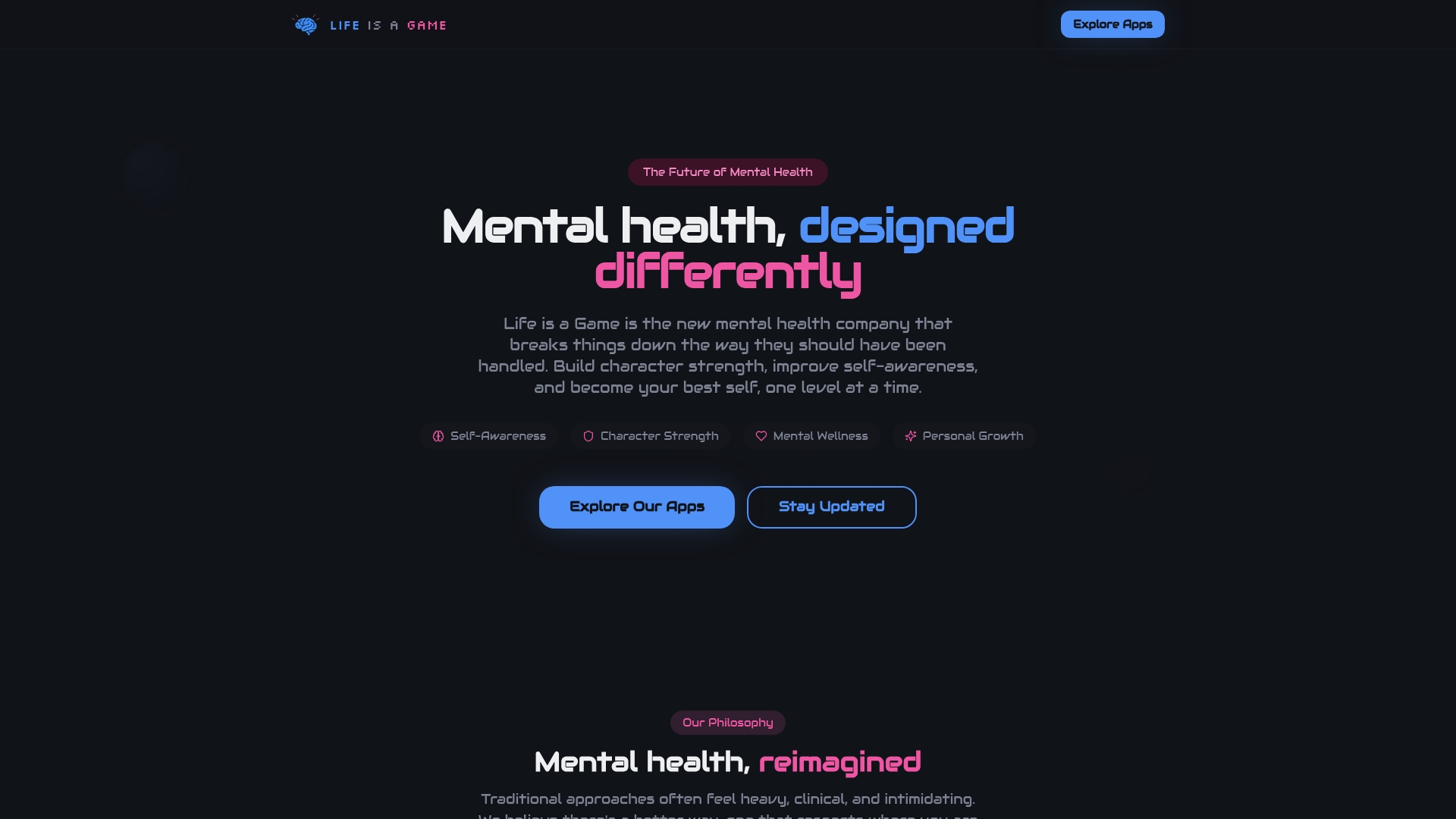
The app's AI Therapist uses evidence-based techniques, including the same CBT frameworks behind the thought records in this guide, to give you guided support between journaling sessions. The Signal not Noise daily anchor helps you identify your three most important tasks each day, which pairs naturally with the planning prompts above. Habit Forge applies the same cue-routine-reward structure described in the habit-building section to keep your journaling practice consistent. Progress is tracked visually, so you can see movement even when it doesn't feel obvious.
Life is a Game is not a replacement for therapy. It's a between-session tool for people who want more than a blank page. Download the free tier and see whether the structure helps.
Further reading and primary sources
- Expressive writing can help your mental health (APA podcast) — explains why causal and insight language in entries predicts better outcomes than venting.
- Journaling and mental health (Sanford Health) — covers gratitude journaling evidence and the 14-day three-good-things protocol.
- Journaling for emotional wellness (UR Medicine) — clinician-oriented overview of journaling as an emotional regulation tool.
- NCBI PMC3759583 — peer-reviewed review of writing intervention studies, including protocol-specific outcome data.
- NCBI PMC6305886 — clinical review identifying structured journaling methods as standard CBT homework tools.
- ADAA anxiety facts and statistics — authoritative prevalence data on anxiety disorders.
- Simply Psychology: anxiety journaling techniques — practical guidance on matching format to anxiety type and avoiding rumination traps.
- HabitBox: how to start an anxiety journal — habit-design guidance including the 5-minute floor rule and anchor habit approach.
- Dartmouth: journaling practices research — supports the weekly review cadence recommendation over daily re-reading.
This article is for general informational purposes only and is not a substitute for professional mental health advice, diagnosis, or treatment. If you are experiencing significant anxiety, please consult a qualified mental health professional.
Sources
- Journaling and mental health (Sanford Health news)
- NCBI article (PMC3759583)
- NCBI article (PMC6305886)
- Journaling for emotional wellness (UR Medicine)
- Expressive writing can help your mental health (APA podcast)