
You can stop rumination right now with a three-step interruption protocol, then reduce it long-term by retraining your thinking with CBT, ACT, or mindfulness. The combination works because rumination is a habit, not a character flaw, and habits respond to consistent, targeted practice.
The immediate protocol:
- Stop and label. Say to yourself, silently or aloud: "This is rumination, not problem-solving." Naming the pattern activates the prefrontal cortex and loosens the thought's grip.
- Breathe. Four counts in, hold for four, out for six. Do this twice. It shifts your nervous system out of threat mode.
- Schedule it. Tell yourself: "I'll think about this at 6 PM for 15 minutes." This is called worry time, and it is one of the most evidence-supported self-help techniques available.
These steps are not invented reassurance. Mindfulness, deliberate distraction, and writing-based externalization are all clinician-recommended first-line strategies for exiting the rumination loop. A controlled study comparing brief interventions in youth found that distraction, problem-solving, and mindfulness each produced measurable reductions in rumination, confirming that multiple routes out of the cycle exist.
Key Takeaways
Rumination is a learned habit that responds to consistent, targeted practice using CBT, ACT, mindfulness, and behavioral activation, with the strongest outcomes coming from interventions that name rumination as the direct target.
| Point | Details |
|---|---|
| Use the three-step protocol immediately | Stop, label the thought as rumination, breathe, and schedule it for worry time. |
| Match the therapy to your presentation | CBT/RBCBT for depression-linked rumination; ACT/ERP for OCD-related intrusive thoughts. |
| Build daily structure | Worry time, a three-task morning list, outdoor movement, and a bedtime brain dump reduce baseline rumination. |
| Avoid suppression and avoidance | Thought-stopping and avoidance worsen the loop; acceptance and labeling are the evidence-based alternatives. |
| Seek help when functioning is impaired | Red flags include sleep loss, compulsive behaviors, and any thoughts of self-harm. |
| Life is a Game for daily practice | The AI Therapist and Habit Forge features support worry-time scheduling, grounding, and habit tracking. |
Table of Contents
- How to stop rumination: what it is and how it differs from worry
- Why rumination starts and what it does to your brain
- Therapies that reliably reduce rumination
- 7 practical techniques to stop rumination
- What to do the moment rumination starts: scripts and decision rules
- Daily habits that reduce rumination over time
- What doesn't work: common rumination traps
- When to seek professional help
- What the research says and how digital tools support practice
- Life is a Game gives you a structured place to practice
- Sources
How to stop rumination: what it is and how it differs from worry
Rumination is repetitive, past-focused thinking that circles the same painful material without reaching a resolution. You replay a conversation from three days ago, rehearse what you should have said, and feel worse each time, yet you keep going back. That loop is the defining feature.
It is easy to confuse rumination with two related patterns:
| Thinking style | Time focus | Goal | Productive? |
|---|---|---|---|
| Rumination | Past | Understand or undo | No — loops without resolution |
| Worry | Future | Prevent or prepare | Sometimes — can prompt action |
| Reflection | Past or present | Learn and move forward | Yes — reaches a conclusion |
Worry at least points toward a future outcome you might influence. Reflection reaches a conclusion and stops. Rumination does neither. It is, as clinicians describe it, a stationary treadmill: you expend real mental energy and go nowhere.
Pro Tip: Ask yourself one question to catch rumination early: "Has thinking about this for the past five minutes brought me closer to a decision or an action?" If the answer is no, you are ruminating, not reflecting.
Why rumination starts and what it does to your brain
Rumination rarely appears out of nowhere. Common triggers include acute stress, social conflict, perceived failure, uncertainty about the future, perfectionism, and physical fatigue. When any of these conditions are present, the mind reaches for a familiar coping move: analyze the problem until it feels resolved. The problem is that rumination is not actually analysis.
Several cognitive distortions keep the loop running:
- All-or-nothing thinking: "I completely failed" rather than "I made one mistake."
- Mind reading: Assuming others judged you harshly without evidence.
- Overgeneralization: Treating a single bad event as proof of a permanent pattern.
- Emotional reasoning: Feeling guilty, so concluding you must have done something wrong.
These distortions are automatic. They feel like facts, which is exactly why they are so hard to dismiss by willpower alone.
The consequences are not just psychological discomfort. Sustained rumination is strongly linked to the onset and maintenance of major depression, generalized anxiety disorder, and OCD. Interventions that directly target rumination produce significantly larger reductions than treatments that address depression or anxiety without naming rumination as the mechanism. That finding matters practically: if rumination is your primary issue, a therapist who targets it explicitly will likely help you more than one who does not.
Therapies that reliably reduce rumination
Not every evidence-based therapy works equally well for every presentation. Here is a practical guide to the main options:
-
Cognitive Behavioral Therapy (CBT): The most widely studied approach. CBT teaches you to identify automatic negative thoughts, test them against evidence, and replace them with more accurate alternatives. It works best when rumination is tied to depression or persistent negative self-evaluation.
-
Rumination-Focused CBT (RBCBT): A tailored adaptation that treats rumination as a learned habit. It identifies the specific triggers that activate the loop, rehearses alternative responses, and builds new behavioral patterns to prevent relapse. Reviews find that interventions explicitly targeting rumination achieve significantly larger reductions than indirect approaches.
-
Acceptance and Commitment Therapy (ACT): Rather than challenging the content of thoughts, ACT teaches cognitive defusion: watching thoughts pass like clouds without fusing with them. The clinical goal is not eliminating negative thoughts but learning to exist alongside them without becoming entangled. This approach suits people who find that arguing with their thoughts only intensifies them.
-
Exposure and Response Prevention (ERP): When rumination is tied to OCD, the loop often functions as a mental compulsion. ACT and ERP specifically target the relationship to intrusive thoughts rather than suppressing them, which is why they outperform standard CBT for OCD-related rumination.
-
Mindfulness-Based Cognitive Therapy (MBCT): Combines mindfulness meditation with CBT skills. Particularly effective for people with recurrent depression who ruminate between episodes.
Pro Tip: If you are unsure which therapy fits your situation, ask a prospective therapist one direct question: "Do you have experience treating rumination specifically, and which approach do you use?" A therapist who names RBCBT, ACT, or MBCT and explains why they chose it for your presentation is a better bet than one who gives a generic answer about "talking through your feelings."
Delivery format matters less than you might expect. Guided online programs with clinician support can produce reductions in rumination comparable to in-person therapy, and they outperform unsupported self-help programs because the clinician guidance increases both adherence and effect size.
7 practical techniques to stop rumination
These techniques range from two-minute interruptions to daily practices. Use the short ones when you are mid-loop; build the longer ones into your routine to reduce how often the loop starts.
1. Mindfulness grounding (5-4-3-2-1)
Name five things you can see, four you can touch, three you can hear, two you can smell, one you can taste. The technique forces sensory attention into the present moment, which is incompatible with past-focused rumination. Takes about two minutes. Most useful when the loop starts suddenly in a public or workplace setting.
2. Cognitive restructuring: Stop, Breathe, Reflect, Choose
Harvard Health outlines a four-step method for changing negative thinking: stop the automatic thought, breathe to reduce physiological arousal, reflect on whether the thought is accurate, and choose a more balanced response. The "reflect" step is where you ask: "What is the actual evidence for this thought? What would I tell a friend in this situation?" Takes about five to ten minutes with practice.
3. Catch it, check it, change it
The NHS Every Mind Matters framework teaches a three-part sequence: catch the unhelpful thought, check it against evidence, and change it to a more neutral or realistic alternative. It is essentially CBT's thought record compressed into a portable habit. Write the thought down, write one piece of evidence against it, and write a replacement. The writing step is not optional: it creates the cognitive distance that silent rumination never achieves.
4. Scheduled worry time
Pick a daily window of time to focus on ruminative thoughts. When a ruminative thought appears outside that window, write it down and tell yourself you will address it at the scheduled time. When the window arrives, sit with the thoughts deliberately. Many people find the thoughts feel less urgent by then. This technique works because it gives the mind a legitimate outlet rather than demanding suppression.
5. Behavioral activation
Rumination thrives in idle time. Behavioral activation means deliberately scheduling activities that require genuine engagement: a brisk walk, cooking something new, calling a friend, or working on a project with clear steps. The activity does not need to be enjoyable at first. The point is to break the passive state that rumination feeds on.

6. Nature exposure
A walk of considerable length in a natural setting decreased self-reported rumination and reduced activity in brain regions linked to self-focused thought, compared to an urban walk of the same duration. Even 20 minutes in a park or green space can shift the pattern. This is one of the most underused techniques in self-help literature, partly because it sounds too simple.
7. Externalizing: write it and put it away
Pro Tip: Write the ruminative thought on paper, fold it, and put it in an envelope. Seal the envelope. The physical act of containment creates genuine psychological distance that typing into a notes app does not replicate. Writing down repetitive thoughts and physically putting the paper away helps the mind disengage from the loop.
What to do the moment rumination starts: scripts and decision rules
Before reaching for any technique, run a quick decision check:
Is this thought about something I can act on right now?
- Yes → Switch to problem-solving mode. Write down one concrete next step. Do it or schedule it.
- No → Use one of the interruption scripts below.
Script 1: Labeling and grounding (2 minutes, anywhere)
- Say internally: "I notice I am ruminating about [topic]."
- Take two slow breaths (4 counts in, 6 counts out).
- Name five things in your immediate environment.
- Return to whatever you were doing.
Script 2: Cognitive reframe at your desk (5–10 minutes)
- Open a notes app or grab paper.
- Write the thought exactly as it appears.
- Write one piece of evidence that contradicts it.
- Write what you would say to a close friend who had this thought.
- Read the friend-version aloud once.
Script 3: Before bed (10 minutes)
- Write down every looping thought in a brief brain dump.
- Mark each one: actionable tomorrow, or not actionable.
- For actionable items, write one next step.
- Close the notebook. Tell yourself: "These are scheduled."
Situational notes:
- Workplace: Script 1 works silently at a desk or in a meeting. No one will notice.
- While driving: Use verbal labeling only ("I notice I'm ruminating") and switch to an engaging podcast or audiobook immediately.
- Before bed: Script 3 consistently outperforms lying in the dark trying not to think.
Daily habits that reduce rumination over time
Single-session techniques interrupt the loop. Daily habits reduce how often it starts. The difference between someone who ruminates occasionally and someone who ruminates chronically is usually not intelligence or willpower. It is the presence or absence of a daily structure that keeps the mind occupied and regulated.
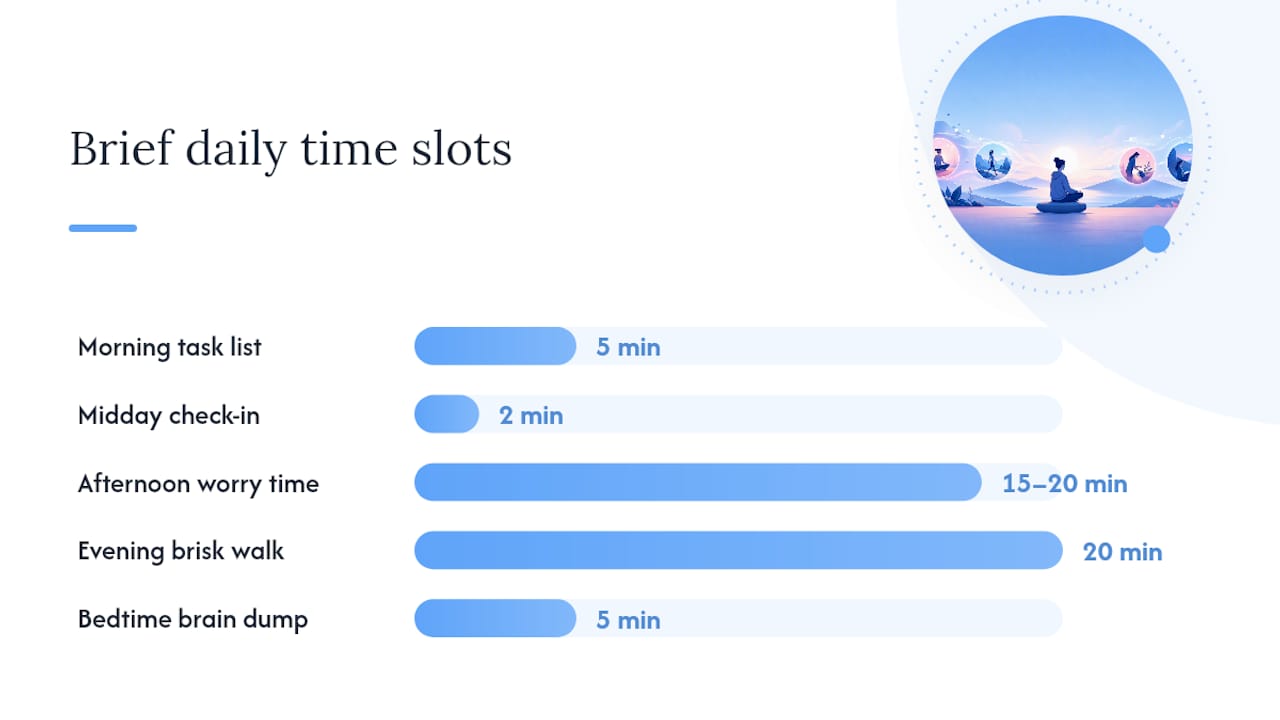
A practical daily framework:
- Morning (5 minutes): Write three tasks for the day using a focused system like Signal not Noise, which limits you to three tasks and prevents the cognitive overload that triggers rumination.
- Midday (2 minutes): Brief mindfulness check-in. Name your current emotional state without judgment.
- Afternoon (15–20 minutes): Scheduled worry time. Sit with any ruminative thoughts that have queued up. Write them, check them, and close the notebook.
- Evening (20 minutes): Brisk walk, ideally outdoors. This is not optional padding: the nature-exposure evidence is strong enough to treat this as a clinical recommendation.
- Before bed (5 minutes): Brain dump and next-step scheduling (Script 3 above).
Building these into a habit tracker matters. When you record which days you completed the worry-time slot and which days you skipped it, patterns emerge: most people find that skipped days cluster around specific triggers (late nights, high-stress meetings, social conflict). Spotting the trigger is half the intervention. A tool like Habit Forge can automate the tracking and send reminders at the times you are most likely to skip.
Self-talk is also a daily practice. Speaking to yourself the way you would speak to a close friend crowds out the harsh internal filter that rumination relies on. This is not positive thinking in the motivational-poster sense. It is a deliberate shift in register: from prosecutor to advisor.
What doesn't work: common rumination traps
Some of the most intuitive responses to rumination make it worse. Knowing what to avoid saves a lot of wasted effort.
- Thought-stopping: Telling yourself "stop thinking about it" is the mental equivalent of trying not to think of a pink elephant. Forced thought suppression tends to increase the intensity and frequency of intrusive thoughts, not reduce them. Replace it with acceptance and labeling.
- Avoidance: Skipping the situation, conversation, or place that triggered rumination feels like relief but reinforces the belief that the trigger is dangerous. Over time, avoidance narrows your life and amplifies anxiety.
- Rumination disguised as problem-solving: This is the most insidious trap. It feels productive because you are "working on the problem." The tell is that you are not generating new information or moving toward a decision. You are replaying the same material. If you have been "thinking it through" for more than ten minutes without reaching a new conclusion, you have crossed from reflection into rumination.
- Venting without resolution: Talking about the same problem repeatedly to friends or family can feel supportive but often extends the loop rather than closing it. Venting is useful once; after that, it is co-rumination.
- Reassurance-seeking: Asking others repeatedly whether you made the right decision or whether they are upset with you temporarily reduces anxiety but trains the brain to need reassurance to function. ACT and ERP both target this pattern directly.
The replacement for all of these is the same: accept the thought's presence, label it, and redirect attention to a concrete, present-moment task.
When to seek professional help
Self-help techniques work for mild to moderate rumination. Several signs indicate that professional support is the right next step.
Red flags that warrant professional care:
- Rumination is interfering with your ability to work, sleep, or maintain relationships
- You have been using self-help strategies consistently for four or more weeks without improvement
- The ruminative thoughts involve self-harm, suicidal ideation, or plans to hurt yourself or others
- Rumination is accompanied by compulsive behaviors (checking, reassurance-seeking, mental reviewing) that you cannot stop
- You are sleeping fewer than five hours regularly because of intrusive thoughts
- The thoughts feel completely outside your control and are escalating
If you are having thoughts of self-harm or suicide, contact a crisis line immediately. In the US, call or text 988 (Suicide and Crisis Lifeline). In the UK, call 116 123 (Samaritans). In Australia, call 13 11 14 (Lifeline). These services are free and available around the clock.
Finding the right clinician:
- Ask specifically about experience treating rumination, not just depression or anxiety.
- Ask whether they use CBT, RBCBT, ACT, or MBCT, and why they would choose one over another for your presentation.
- If OCD-related rumination is a possibility, ask about ERP specifically.
- Inquire about guided online programs if in-person access is limited.
- Check whether your insurer covers mental health visits, or whether sliding-scale options are available.
Rumination is one of the most treatable cognitive patterns in clinical psychology. The barrier is usually not the absence of effective treatments but the delay in seeking them.
What the research says and how digital tools support practice
The strongest evidence lines in rumination research converge on a consistent picture. CBT and its rumination-focused variant (RBCBT) produce reliable reductions when rumination is the primary target. ACT and mindfulness-based approaches work through a different mechanism, defusion rather than restructuring, but achieve comparable outcomes. Nature exposure reduces both self-reported rumination and measurable neural activity in self-referential brain regions. And guided online programs, when they include clinician support, match in-person therapy on most outcome measures.
What the research also shows is that repetition and tracking are not optional extras. Adherence to practice is the single largest predictor of outcome in self-guided programs. This is where digital tools earn their place.
- Habit tracking makes the daily practices visible and creates accountability without requiring a therapist appointment.
- Worry-time scheduling built into an app removes the friction of remembering to do it.
- Grounding and breathing exercises available on demand mean the two-minute protocol is always one tap away.
- Exposure micro-tasks allow gradual, structured practice of the behaviors that rumination drives you to avoid.
- Progress tracking shows you that the loop is becoming less frequent, which is itself motivating.
Interventions that directly target rumination achieve significantly larger reductions than those that address it indirectly. A structured digital tool that names rumination as the target and builds the evidence-based techniques into daily use is doing exactly what the research recommends.
An honest note on what this actually takes
Most articles about rumination end with a list of techniques and the implicit promise that reading them is most of the work. It is not. The techniques in this guide are genuinely effective, but they require repetition before they become automatic. The first time you try the labeling script, your brain will resist it. The thought will feel too urgent, too real, too important to simply name and set aside. That resistance is normal and not a sign that the technique is failing.
What I find most useful to tell people at this point is this: the goal is not to have fewer thoughts. It is to spend less time trapped inside them. That is a different target, and it is a more achievable one. You are not trying to become someone who never revisits a painful memory. You are building the skill of noticing when you have crossed from reflection into the loop, and redirecting before the loop runs for an hour.
Start with one technique. The scheduled worry time is the easiest entry point for most people because it requires no in-the-moment skill, just a calendar entry. Add a second technique after a week. Track whether the loops are getting shorter, not whether they are disappearing.
Life is a Game gives you a structured place to practice
Knowing the techniques is one thing. Having a system that prompts you to use them, tracks whether you did, and adjusts the difficulty as you improve is another. Life is a Game is built specifically for this gap.
The app suite maps directly to the techniques in this guide. The AI Therapist runs evidence-based conversation flows for cognitive restructuring and grounding, available any time the loop starts, not just during office hours. Habit Forge automates your daily worry-time slot, mindfulness check-in, and evening brain dump so the structure runs even on high-stress days when you are least likely to remember it. Signal not Noise keeps your daily task list to three items, which directly reduces the cognitive overload that triggers rumination in the first place.
The free tier gives you enough to start. For readers dealing with severe or OCD-related rumination, in-person clinical care remains the appropriate first step, and Life is a Game works best as a complement to that care, not a replacement. For everyone else, download the app and open the AI Therapist today.
Sources
The following sources informed this guide and are worth bookmarking for deeper reading or sharing with a clinician:
- Rumination and the cycle of negative thinking
- Try this: How to change your negative thoughts
- Reframing unhelpful thoughts — Every Mind Matters (NHS)
- Getting Out of Rumination: Comparison of Three Brief Interventions in a Sample of Youth
FAQ
What is the fastest way to stop rumination in the moment? Label the thought ("this is rumination"), take two slow breaths, and name five things you can see. This grounds attention in the present and interrupts the loop within two minutes.
How is rumination different from worry? Worry is future-focused and can sometimes prompt useful action. Rumination is past-focused and loops without reaching a resolution or decision.
Can rumination cause depression? Sustained rumination is strongly linked to the onset and maintenance of depression and anxiety. Treating rumination directly, rather than only treating depression, produces larger improvements.
Does rumination overlap with OCD? Yes. In OCD, repetitive mental reviewing often functions as a compulsion. ERP and ACT are the recommended treatments for this presentation because they target the relationship to the thought rather than its content.
Is rumination linked to ADHD? ADHD and rumination frequently co-occur. Difficulty shifting attention, a core ADHD feature, makes it harder to disengage from a ruminative loop. Behavioral activation and structured daily routines help both conditions.
When should I see a therapist for rumination? Seek professional support when rumination is disrupting sleep, work, or relationships, when self-help strategies have not helped after four weeks of consistent use, or when any thoughts of self-harm are present.
Do apps actually help with rumination? Guided digital programs with structured practice and tracking support adherence, which is the main predictor of outcome in self-guided programs. Apps work best as a complement to, not a replacement for, clinical care when symptoms are severe.
This article is general information, not a substitute for advice from a qualified doctor. Consult a qualified healthcare professional about your own circumstances before acting on anything here.